
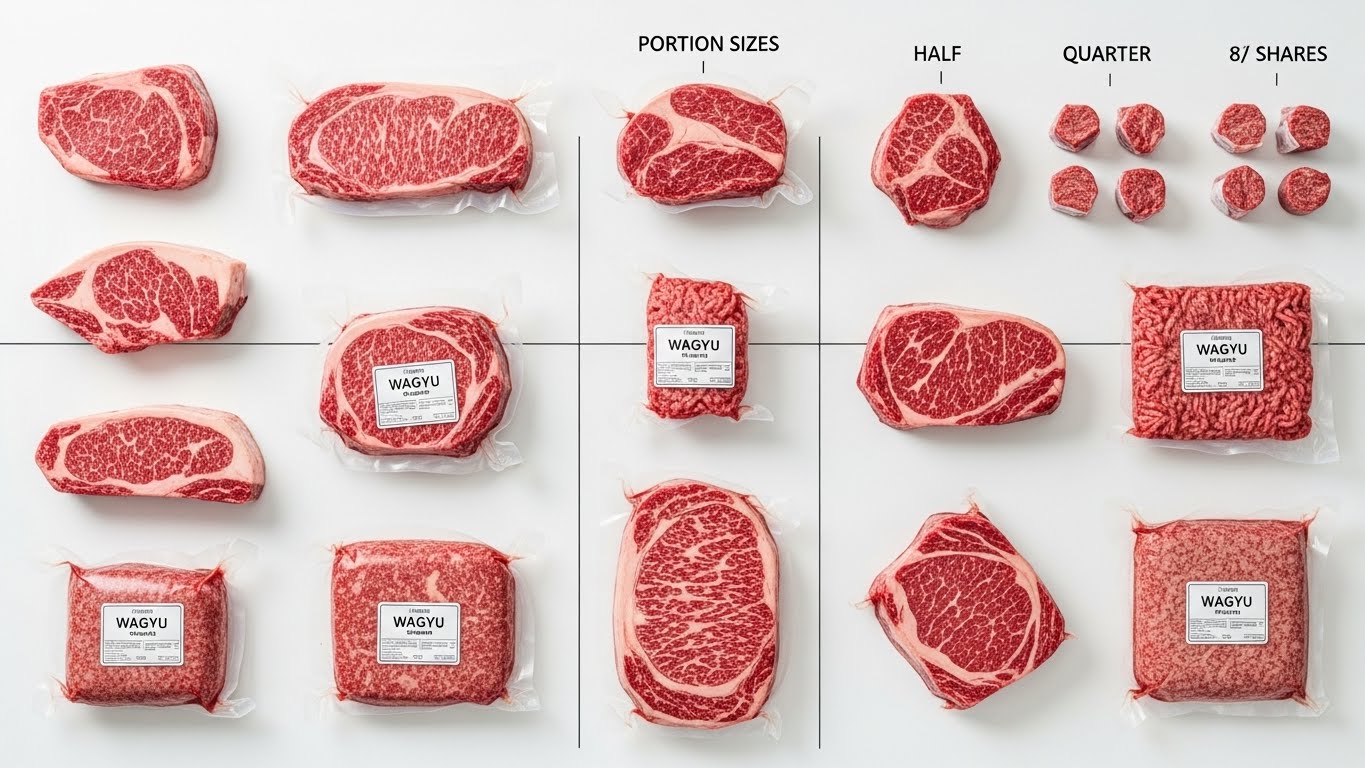
At Mossyrock Wagyu, we offer the options of buying a Full, Half, or Quarter share. When our next steers are ready to go to market, we will display their picture and you can choose which one you want a share of. We are currently offering Beef Box Bundles, Ground Beef, and a limited number of individual cuts. As our herd grows, we will be offering more selection on our website. Also in the future, we will also be offering live animals for sale for you to raise on your own farm. Stay tuned. For all Full and Half share orders, you get to determine how it is cut. Like more steaks? Prefer more roasts? Prefer more ground beef? Prefer less hamburger? Want the heart, live, and tongue along with your steaks? You decide! How you cut it is between you and our USDA Butcher. This is your best value for money in buying our 100% Japanese Wagyu.
We price our Beef Shares using “Live Weight” for pre-harvest orders and “hanging weight” for post-harvest orders. “Hanging Weight” is the carcass weight after slaughter and with all of its internal organs, head, legs, and outer skin removed. The whole carcass is cut into two halves and hung to dry age for 14-21 days depending on the fat content. The more fat, the longer we can age it. The butcher sends us a report listing the animal identifier, its live weight, and the hanging weight of each half. When butchering an animal, this is the term the butcher uses to base his processing charge (butcher fee). We use the same to price our shares.
If you ordered a Half share, one half will be assigned to your order. If you ordered a Quarter, then a half will be assigned to your order and you will receive an equal share of all cuts from that half in proportion to your share. The larger the share, the lower the price per pound. Hamburger will represent about 30–35% of your meat order.
Regardless of how you direct the butcher to cut your order, you will get the same amount of meat. Packaged Weight will differ depending on whether you asked for bone-in or boneless steaks, roasts, and ribs. Our butcher vacuum-seals each steak in packs of 2 unless you instructed otherwise. If you ordered a Full Share with one half cut bone-in and the other half boneless, the packaged weight of the bone-in boxes will weigh significantly more. The difference in weight is the bone still attached to the meat. We price our shares assuming boneless, so you’re not paying a premium for bones.
Packaged weight (or “boxed weight” or “delivered weight”) is the actual weight of the meat you will put in your home freezer. The packaged weight reflects your cutting instructions (e.g., boneless steaks vs. bone-in steaks) and includes the beef cut, ground, wrapped, and frozen.
The packaged weight of bone-in is about 85% of hanging weight.
The packaged weight for boneless is usually 60–65% of the hanging weight.
The loss from hanging weight comes from water loss during dry aging and bone loss during butchering. The more boneless cuts you request, the lower the packaged weight will be. Lower weight doesn’t mean less meat—it means fewer bones.
If a steer has a live weight of 1,200 pounds, its hanging weight is approximately 720 pounds (60% of 1,200). A hanging weight of 720 pounds would result in:
680–700 pounds of bone-in meat, or
430–470 pounds of boneless meat (60–65% of 720 lbs).
The only difference in price to you is that boneless orders save on shipping costs.
To better your understanding of the terminology we use, here are some common terms:
Live weight (or “on the hoof”) – the weight of a steer or cow when alive.
Hot carcass weight – the weight immediately after slaughter, before aging, cutting, or trimming; interchangeable with hanging weight.
Hanging weight (or “on the rail”) – the weight of the slaughtered and dressed animal with hide, head, hooves, blood, and most organs removed. Dry-aged for 14–21 days, resulting in about 2% moisture loss. Typically 60% of live weight. This is not the amount of beef you will put in your freezer.
Package Weight (scale weight) – the final weight delivered to your door, including meat, bones (if bone-in), vacuum packaging, and container packaging.
Butcher Pricing – We use a USDA-certified butcher. His fee, based on the hanging weight being processed, is included in our product pricing. The fee includes slaughtering, dressing, processing, and packaging.
A general rule of thumb is 1 cubic foot of freezer space for every 30–35 lbs of cut and wrapped meat. Bone-in will take more space. A quarter cow fits in a small chest freezer; a whole cow needs a large chest freezer.
I hope this helps you better understand how much meat you will receive with your order and prevents surprises when you learn that a pound of hanging weight is not a pound of packaged meat. Rest assured, you are only paying for the meat you eat.
Order bone-in and the bone is free for your dog to enjoy! What dog wouldn’t want a Wagyu bone to gnaw on?
Discount Applied Successfully!
Your savings have been added to the cart.
You're now part of our rewards program! Start earning points and rewards with every purchase.
Start earning pointsCreate a free account to start earning points and unlocking member-only perks.
Already have an account?
Welcome back! Sign in to access your rewards.
Don't have an account?
Share your link with friends. They get a reward and you earn one when they purchase.
You were sent a gift
Enter your email to claim it now.
Unknown panel state:
Already have an account?
Already have an account?
Requires an account to redeem
Redeem rewards now
Turn your into discounts and perks
Instant setup
One click and you're ready to go
Earn even more
Get +1,000 bonus for signing up
Redeemed
Use this coupon on your next order
Start earning to unlock your first reward
You're now part of our rewards program! Start earning points and rewards with every purchase.
Start earning pointsCreate a free account to start earning points and unlocking member-only perks.
Already have an account?
Welcome back! Sign in to access your rewards.
Don't have an account?
Share your link with friends. They get a reward and you earn one when they purchase.
You were sent a gift
Enter your email to claim it now.
Unknown panel state:
Already have an account?
Already have an account?
Requires an account to redeem
Redeem rewards now
Turn your into discounts and perks
Instant setup
One click and you're ready to go
Earn even more
Get +1,000 bonus for signing up
Redeemed
Use this coupon on your next order
Start earning to unlock your first reward